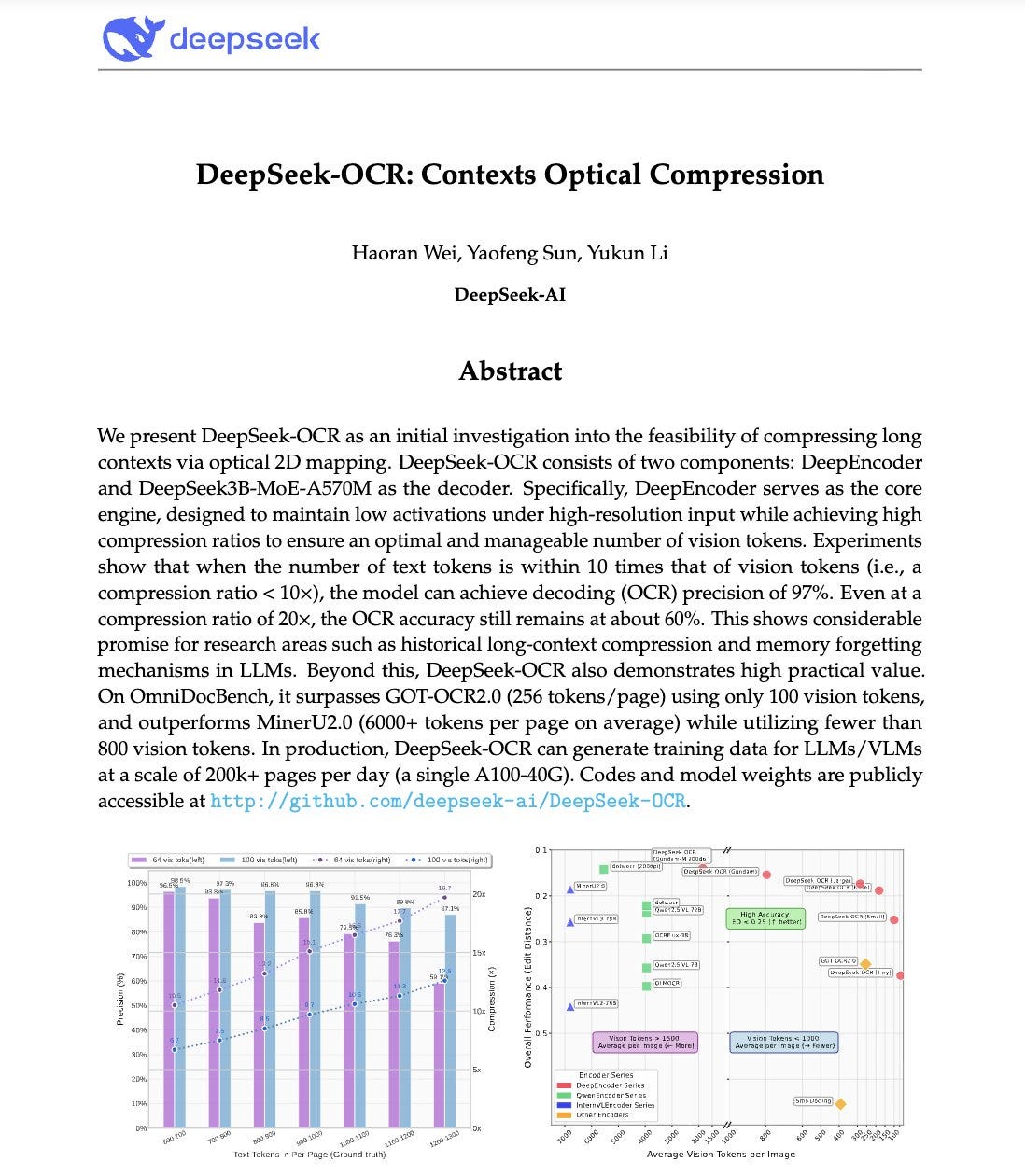
This moment in AI feels eerily familiar — just as JPEG compression once transformed how the world stored and shared visuals, optical compression is now revolutionizing how AI perceives, remembers, and processes information. It’s not an incremental step; it’s a paradigm shift that could redefine data efficiency, memory architecture, and even the economics of AI computation.
The JPEG Moment for AI
DeepSeek’s Optical Context Compression is the breakthrough leading this transformation. Instead of reading text linearly like traditional LLMs, DeepSeek encodes entire documents into vision tokens — visual abstractions that pack dense semantic information into compact optical form. Each token becomes a compressed “pixel of meaning,” making the idea of infinite context windows suddenly plausible.
Imagine taking a photo of a busy park filled with people, dogs, benches, and trees. Now imagine an AI that can not only see every object but also understand what each one is — all while using dramatically fewer resources.
This is exactly what DeepSeek-OCR achieves. At its core is the DeepEncoder, powered by two standout models: SAM (Segment Anything Model) and CLIP (Contrastive Language-Image Pretraining). SAM is like a visual scalpel — it segments the image by precisely outlining objects, such as isolating a single dog from the grass or identifying every bench in a scene. Meanwhile, CLIP gives those shapes meaning by connecting what the AI sees to words it has learned, labeling the dog as a “dog” and distinguishing people from other objects.
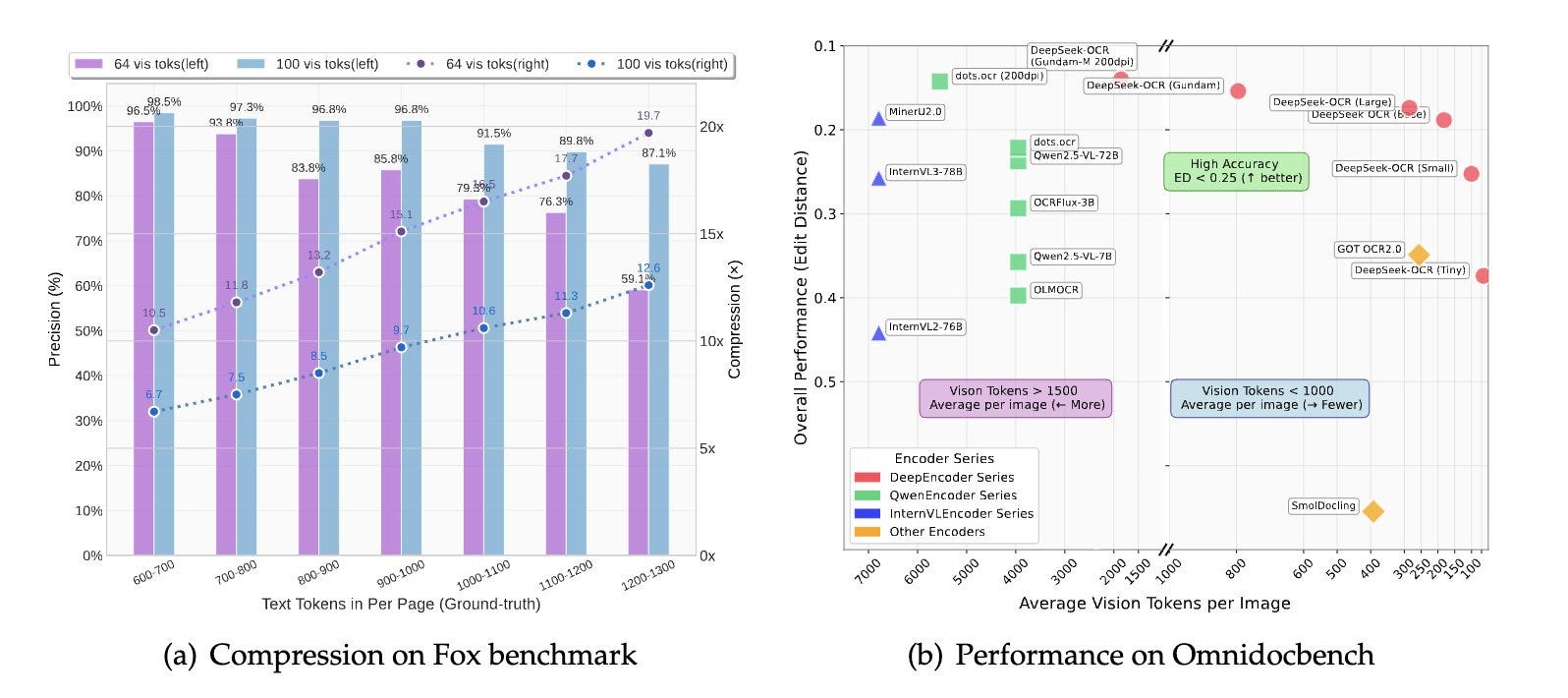
The result? Thousands of image patches are compressed into just a few hundred highly efficient “vision tokens.” Thanks to this, DeepSeek-OCR provides up to 10× compression with 97% decoding accuracy and 60% accuracy even at 20× compression — all while outperforming traditional models like GOT-OCR2.0 using up to 60× fewer tokens.
This optical compression breakthrough slashes the cost of memory and computation, enabling AI to process far longer and more complex documents in real time. It’s a shift akin to how JPEG changed digital images, making previously impossible tasks practical and affordable.
In short, DeepSeek isn’t just improving AI memory — it’s rewriting the rules, opening doors to AI that can finally remember and understand vast amounts of information without breaking a sweat.
Goodbye RAG: The End of Chunk & Fetch
Retrieval-Augmented Generation (RAG), once the hero of long-context tasks, now looks antiquated. Why retrieve when you can compress entire libraries into your context window? With optical encoding, a million tokens of text become 100,000 vision tokens — enabling models to retain full-context reasoning without retrieval hops.
This creates a new discipline: Context Engineering — where efficiency depends not on retrieval recall but on semantic compactness. As Yanze Liu of Google wrote, “RAG is not dead — but it’s getting replaced by something more elegant: continuous context compression”.
Memory and the Natural Forgetting Curve
AI’s greatest limitation has always been memory. Long-term context collapses and infinite chat sessions degrade performance as the model loses track of prior states. DeepSeek’s progressive compression introduces an elegant analog to the human forgetting curve — allowing AI agents to remember less, but remember better. By summarizing and re-encoding memory naturally over time, agents can run indefinitely, recalibrating memory weight like biological cognition.
The AI-Crypto Convergence
Meanwhile, an unexpected frontier has emerged: AI trading bots battling human traders. On Binance’s “Alpha Arena” leaderboard, DeepSeek Chat V3.1 achieved nearly 20% profit in three days using an ETH 15× long position, outperforming both Claude Sonnet and GPT-5. Most models employed structured stop-loss and take-profit conditions — risk strategies humans often ignore. The next trading era might resemble an AI vs. AI metagame: CEXs and DEXs filled not with humans reacting emotionally, but with autonomous agents competing across milliseconds.
Just as DeepSeek’s visual compression frees AI from textual constraints, its trading AI demonstrates that discipline, speed, and probabilistic reasoning are not human monopolies anymore. The question is no longer “Can we beat AIs?” but “What market inefficiencies will be left once they’re done optimizing?”
AI Becomes Real-Time and Accessible
Optical compression also marks a leap for real-time AI. Tasks once computationally excessive — live document summarization, streaming OCR, or on-the-fly translation — now become cost-effective. Because visual encoding reduces token dependency, even edge devices or embedded systems could soon support intelligent perception without cloud latency.
This aligns with broader efforts in optical computing — where data literally travels as light. Recent studies show optical neural processors can embed parameters directly in photonic circuits, achieving up to 90% energy savings and true parallelism. DeepSeek’s pathway could be the first real bridge between digital transformers and analog light-based intelligence.
The New AI Stack: Vision as Memory
If past years were defined by “bigger models,” the next frontier is smarter memory architectures. DeepSeek’s compression redefines what “context” means — it’s no longer about token count but information density. Agents won’t just recall — they’ll visually reconstruct understanding, mirroring how humans think in images and scenes.
This is why technologists are calling it the “JPEG moment for AI”: a single step that changes the entire cost curve of intelligence.
Just as JPEG made the Internet visual, optical compression may make AI conscious — not in the philosophical sense, but in the architectural one: memory, perception, and inference converging into a single continuous representation of context.
The AI era isn’t slowing down — it’s entering a new wavelength.