
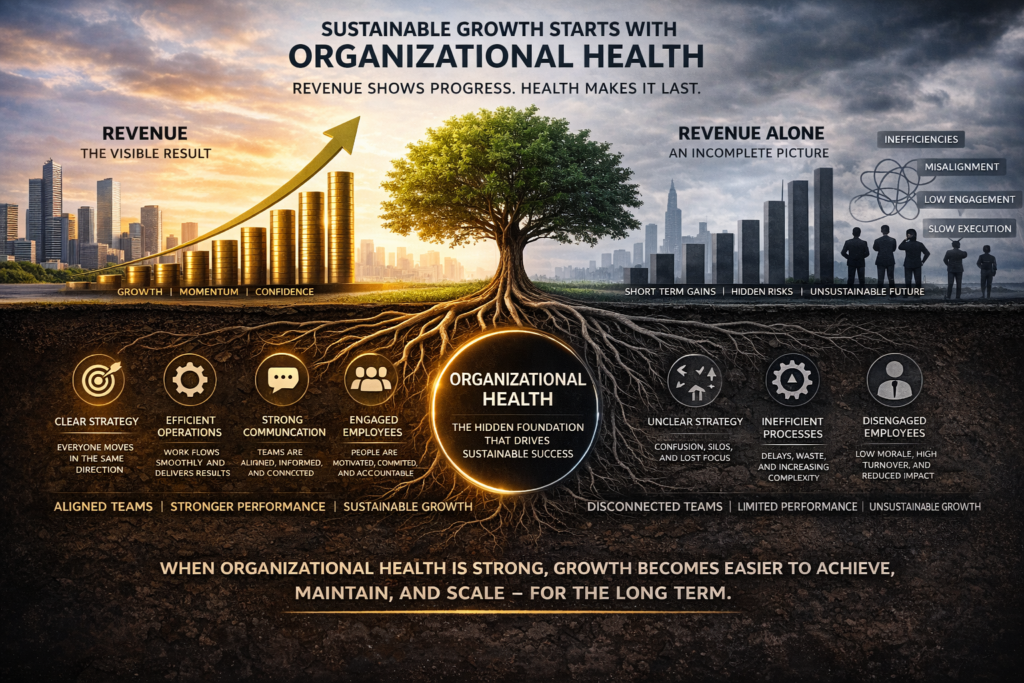
Revenue is often treated as the ultimate measure of success in a business. It is the number that leaders, investors, and teams focus on the most. When revenue grows, it creates confidence. It signals progress, momentum, and validation. But revenue alone does not tell the full story of what is happening inside a company. Many organisations continue to grow financially while struggling internally with inefficiencies, misalignment, and execution challenges. These internal issues are not always visible in financial reports, but they directly impact the company’s ability to sustain growth over time. A business can appear successful on the surface while gradually weakening beneath it.
Organisational health is what determines whether a company can sustain and scale its growth effectively. It reflects how well the different parts of the business work together. It includes how clearly strategy is understood, how efficiently operations function, how well teams communicate, and how engaged employees feel in their roles. When these elements are aligned, companies operate with clarity and speed. Decisions are made faster, execution is smoother, and teams move in the same direction. When they are not aligned, even simple tasks begin to feel difficult, and progress becomes inconsistent.
One of the biggest challenges is that most companies do not actively measure organisational health. They rely heavily on financial performance while ignoring the internal factors that drive it. Leaders may assume that if revenue is growing, everything else must be functioning well. But in reality, internal inefficiencies can exist for long periods without being noticed. Over time, these inefficiencies compound, making the organisation slower, more complex, and harder to manage.
Companies that prioritise organisational health tend to outperform others in the long run. They adapt faster to change, maintain higher productivity, and retain stronger teams. They are able to scale without losing clarity or control. In contrast, companies that ignore internal health often face delays, communication gaps, and execution issues that limit their growth potential. The difference is not always visible in the early stages, but it becomes significant over time.
Understanding what is happening inside the organisation is just as important as tracking what is happening outside. Financial growth shows where the company is going, but organisational health determines how effectively it can get there. The companies that sustain growth are not the ones that only focus on numbers, but the ones that pay attention to how their system is functioning beneath those numbers. Because when internal health is strong, growth becomes easier to maintain, but when it is weak, growth eventually becomes harder to sustain.