
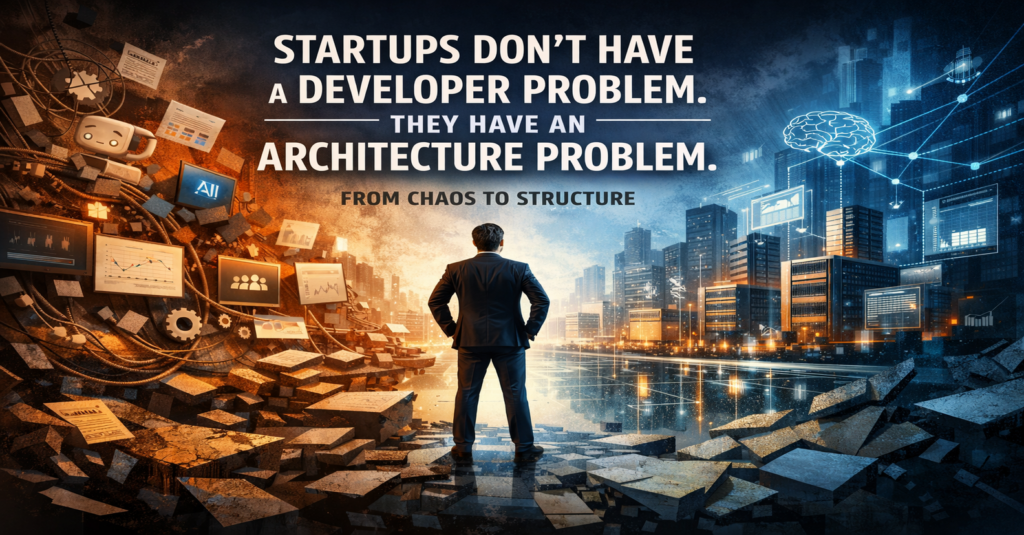
They Have an Architecture Problem.
Ten years ago, I wasn’t frustrated with technology.
I was frustrated with how disconnected everything felt.
Startups were moving faster than ever.
Funding cycles were shrinking.
AI was becoming powerful.
From the outside, it looked like progress.
From the inside, it often felt like chaos.
Marketing teams were juggling 12–15 tools that barely spoke to each other.
Product teams were shipping features into workflows no one had fully mapped.
Revenue teams were reconciling numbers across spreadsheets, Slack threads, and dashboards that told different stories.
Everyone was busy.
Very few were aligned.
Then AI entered the picture.
And instead of stepping back to rethink how systems worked, most companies layered AI on top of the fragmentation.
A chatbot here.
A generative tool there.
An automation script duct-taped between platforms.
It looked intelligent.
But it wasn’t structured.
And that difference matters.
Because AI isn’t magic.
It’s structured probability operating within defined boundaries.
If your boundaries are unclear, your outputs will be unpredictable.
At this point, I kept hearing the same solution:
“We just need more developers.”
But developers don’t fix fragmentation.
They accelerate whatever already exists.
If your system is structured, acceleration creates leverage.
If your system is fragmented, acceleration creates chaos — just faster.
That’s where most startups misdiagnose the problem.
They assume:
More speed equals more progress.
More tools equal more capability.
AI integration equals intelligence.
But speed without architecture creates invisible debt.
Tool sprawl increases cognitive load.
Disconnected workflows leak revenue.
Manual approvals buried in Slack create bottlenecks no dashboard ever captures.
And the cost doesn’t show up immediately.
It compounds quietly.
Every new tool introduces another integration layer.
Another dependency.
Another potential sync issue.
Another workflow inconsistency.
Over time, something starts to feel off.
Meetings increase.
Clarifications multiply.
Approvals stall.
Data conflicts surface.
At that point, companies think they need more effort.
They don’t.
They need clarity.
Architecture isn’t just about code.
It’s about how the business actually works.
It’s the invisible blueprint that decides:
How marketing connects to revenue.
How product decisions are validated.
How AI receives context.
How approvals flow.
How analytics inform strategy.
When architecture is right, you don’t notice it.
Teams move smoothly.
Decisions don’t require five escalations.
AI behaves predictably.
Data flows without friction.
When architecture is missing, complexity grows silently — until it becomes expensive.
That realization is why Drylogics was started.
Not to build features.
Features expire.
Not to “provide developers.”
Developers without architectural continuity often multiply complexity.
We started with a simple belief:
Technology without architecture creates chaos.
Most companies don’t have a marketing problem.
They don’t have a developer problem.
They don’t even have an AI problem.
They have a systems problem.
Marketing operating systems are fragmented.
Lead-to-cash flows are undefined.
AI layers are ungoverned.
What looks like growth is often controlled instability.
And instability does not scale.
There’s also a myth that structure slows innovation.
It doesn’t.
Structure reduces cognitive load.
And when cognitive load drops:
Teams think better.
AI performs better.
Workflows stabilize.
Decisions happen faster.
Architecture doesn’t reduce speed.
It turns chaos into leverage.
I’ve seen how small inefficiencies compound.
A 3% workflow gap doesn’t feel urgent.
But over 24 months, it becomes operational drag.
It becomes revenue leakage.
It becomes morale erosion.
The deeper truth is this:
Companies don’t need more tools.
They need fewer decisions.
And fewer decisions only happen when systems are designed intentionally.
When workflows are mapped.
When data models are unified.
When AI sits inside governance, not outside it.
When marketing structurally connects to revenue.
Good architecture is invisible.
But bad architecture is loud.
Drylogics exists to design that invisible layer.
Not features.
Not tickets.
Systems.
Because systems compound.
Fragments collapse.
And in the AI decade ahead, the companies that win won’t be the fastest builders.
They’ll be the most structured architects.