
I’ve noticed something over the years.
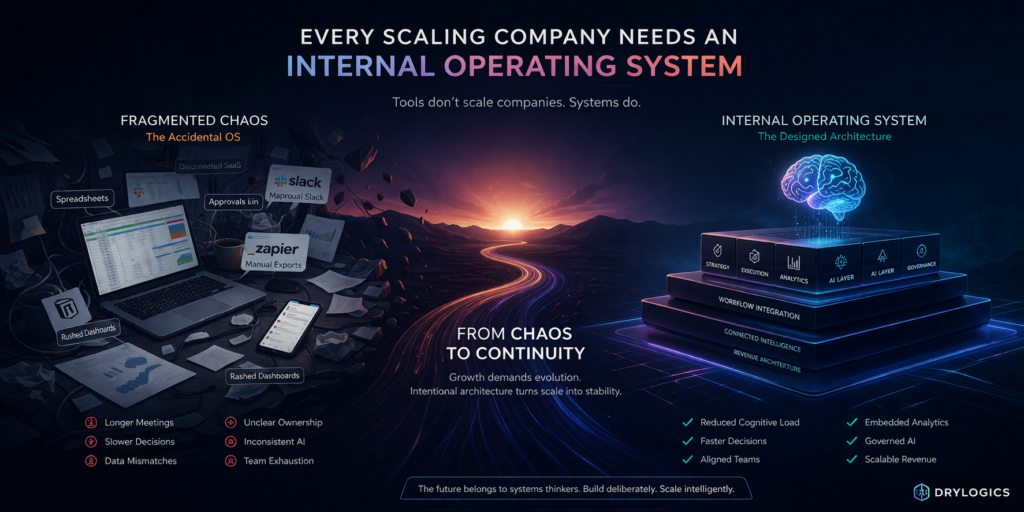
Every company already runs on an operating system.
The real question is — was it designed… or did it just happen?
In the early stages, it’s usually accidental.
A few spreadsheets.
Some disconnected SaaS tools.
Approvals happening in Slack.
Manual exports.
Dashboards built in a rush.
And honestly?
It works.
For a while.
When the team is small, alignment feels natural. Everyone sits close to the problem. Decisions are quick. Context is shared automatically.
But then growth happens.
More customers.
More team members.
More tools.
More AI integrations.
More data sources.
And if the architecture doesn’t evolve with that growth, friction starts multiplying quietly.
What I’ve seen many founders do at that stage is assume the problem is capacity.
“We need more developers.”
“We need more marketers.”
“We need more operations support.”
But if the underlying system is fragmented, new hires don’t fix the chaos.
They amplify it.
Because people don’t fix architecture.
Systems do.
At some point, every scaling company faces the same uncomfortable question:
What actually runs this business?
Is it spreadsheets?
Is it a stack of SaaS tools loosely connected?
Is it Slack threads and manual coordination?
Or is it something intentional?
Not software.
Architecture.
An internal intelligence layer that connects strategy to execution, execution to analytics, analytics to AI, and all of it back to revenue.
This is where many companies get confused.
They mistake buying tools for building systems.
They purchase platforms.
They add automation.
They subscribe to the latest AI solution.
But tools don’t scale companies.
Systems do.
An internal operating system isn’t a product you install.
It’s a designed infrastructure layer that:
Reduces cognitive load.
Aligns teams structurally.
Defines how decisions move.
Embeds analytics into daily workflows.
Governs how AI behaves.
Prevents revenue leakage.
Without it, scale creates instability.
You start seeing the symptoms:
Meetings get longer.
Decisions get slower.
Data doesn’t match.
Ownership becomes unclear.
AI outputs feel inconsistent.
The team feels tired.
And often, people think it’s a talent issue.
It’s not.
It’s architectural absence.
AI will define the next decade.
But AI without infrastructure is noise.
If context memory isn’t defined…
If governance layers aren’t clear…
If data architecture is fragmented…
If lead-to-cash flows aren’t structured…
AI becomes something humans constantly correct.
And when humans are constantly correcting AI, leverage disappears.
The real growth engine isn’t headcount.
It’s infrastructure.
Marketing must operate as a system, not a series of campaigns.
Revenue must flow through structured processes, not manual approvals.
AI must sit inside governance boundaries, not float as a detached feature.
The future won’t belong to the fastest builders.
It will belong to systems thinkers.
The companies that win long-term will design internal operating systems that:
Reduce fragmentation.
Embed intelligence at the workflow level.
Connect marketing structurally to revenue.
Create continuity across product evolution.
Scale without increasing cognitive chaos.
That’s the vision behind Drylogics.
We’re not a dev shop.
We’re not a feature factory.
We’re architects of internal clarity for AI-driven businesses.
We don’t believe in bursts of velocity.
We believe in continuity.
Because continuity compounds.
Patchwork collapses.
I’ve seen founders wait too long to rethink architecture.
They wait until friction becomes visible.
By then, technical debt is embedded everywhere.
And retrofitting structure is always harder — and more expensive — than designing it intentionally from the start.
Architecture is invisible when it’s done right.
But it determines who survives the scale.
Companies don’t outgrow systems.
They collapse under poorly designed ones.
The next decade will reward structured intelligence.
AI-native architecture.
Intentional internal operating systems.
The question isn’t whether you’ll build one.
It’s whether you’ll build it deliberately — or accidentally.
— Drylogics