
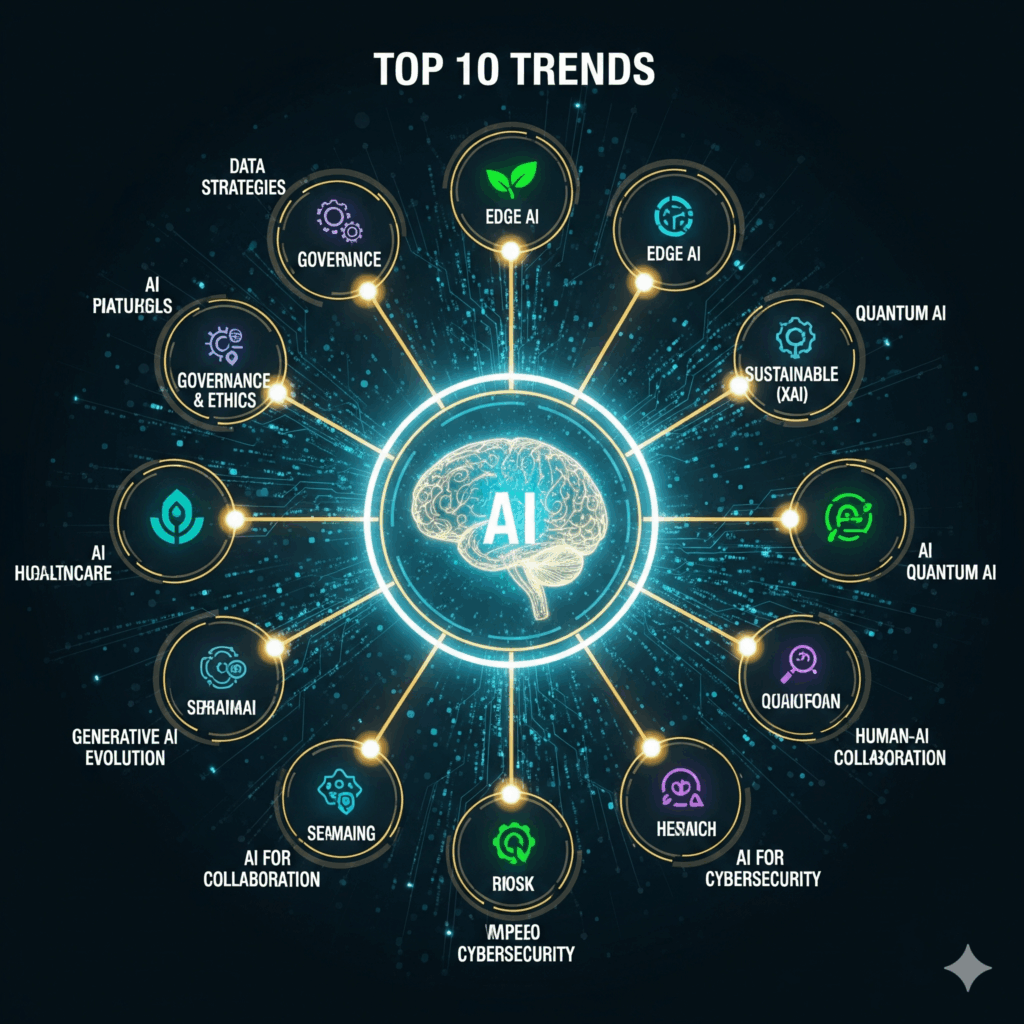
Revamping Data Strategies: Major corporations will reassess their data strategies, investing more time & resources into ensuring that the data fed into their AI models is high-quality & well-structured. This shift will prioritize data integrity & relevance, laying a stronger foundation for effective AI applications.
• Enhanced Workflow & Governance: Companies will place greater emphasis on improving workflow & communication processes related to AI governance across various functions & business units. Effective checks & balances among key stakeholders will be essential; even with a solid data & AI strategy, poor governance can hinder successful outcomes.
• AI CoEs: Many organizations will establish AI CoEs to tackle governance and process challenges. These centers will help standardize practices, ensure regulatory compliance, enhance data integrity, & foster innovation while addressing the ethical implications of AI technologies.
• Edge Computing: As businesses recognize that the RoI for AI is a long-term endeavor, there will be a shift toward processing AI models at the edge rather than in the cloud. This transition will provide greater control over data privacy & security while reducing latency, enabling quicker decision-making in real-time scenarios.
• Cost-Effective Processing Solutions: Startups may begin collaborating with major chip manufacturers to develop CPU/LPUs specifically designed for processing LLMs and SLMs. This innovation aims to lower the high costs associated with training & inference in AI models, which are expected to escalate over time.
• Adoption of Router Mechanisms: A notable trend will be the increasing use of “router mechanisms” by companies to navigate between open-source & closed-source LLMs & SLMs based on specific use cases. This flexibility will allow organizations to optimize their AI solutions according to varying project requirements.
• Diverse Approaches Beyond Generative AI: Companies will recognize that generative AI isn’t a universal solution & will explore various AI techniques to address unique use cases efficiently. Multimodal AI systems may position generative AI as the main natural language interface for future computing.
• Sales & Marketing: Organizations will enhance their sales and marketing efforts by adopting Customer Data Platforms (CDPs) with AI capabilities, improving lead scoring & conversion rates through a comprehensive view of customers.
• Emergence of New AI Form Factors: A rise in new AI form factors will occur, capturing voice, audio, text, and video. Companies will leverage diverse data sources to advance toward AGI, anticipated between 2030 & 2035.
• Sustainable Energy Solutions: Rising operational costs due to electricity consumption will drive the adoption of alternative energy sources like clean nuclear power. More data centers will emerge as “AI factories,” supporting the computational needs of AI while promoting sustainability.