
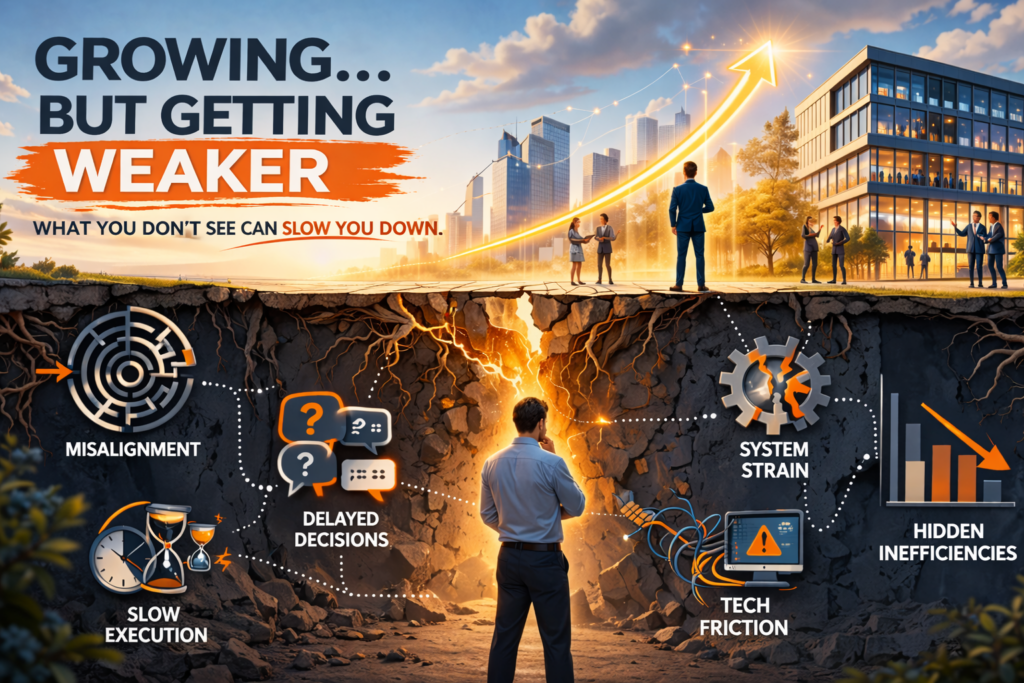
Growth feels like progress. More revenue, more customers, more people. From the outside, everything looks like it is working. Numbers are improving, teams are expanding, and momentum appears strong. For most leaders, these are clear signs that the company is moving in the right direction. But inside many growing companies, a different reality begins to form. Growth does not just create opportunity, it also creates pressure, and in many cases that pressure quietly builds inside the system without being noticed. Most leaders do not see it early. Revenue is the most visible signal in a business, but it is also one of the most misleading. A company can grow financially while becoming weaker operationally. Teams can expand while becoming less aligned, execution can slow down, decisions can get delayed, and systems can struggle to scale. Growth does not fix these problems, it hides them, allowing deeper structural issues to remain unnoticed while the business continues to expand.
In many organisations, strategy exists clearly at the leadership level, but as it moves across teams it becomes interpretation. Different departments begin to understand priorities in slightly different ways, and while this does not cause immediate failure, it gradually weakens execution. Teams continue to work hard, but not always in the same direction, and over time this creates inefficiencies that are difficult to diagnose. This kind of misalignment rarely appears in reports or dashboards, but it becomes visible in confusion, delays, and missed opportunities. As companies grow, specialization increases, which is necessary, but it also introduces new challenges. Sales focuses on revenue, operations on efficiency, product on delivery, and each function improves individually, yet collectively the organization begins to slow down. Communication becomes less direct, coordination requires more effort, and decisions that were once simple begin to take longer. This is not because teams are underperforming, but because the system has become more complex than it was designed to handle.
One of the earliest signs of internal weakness is not performance, it is energy. In the early stages of a company, teams are driven by clarity and momentum, but as complexity increases, that energy often begins to shift. Teams remain busy and work continues, but something feels different. There are fewer ideas, less ownership, and a noticeable drop in urgency. These changes are subtle and often go unmeasured, yet they directly influence productivity, innovation, and long-term growth. At the same time, technology, which is meant to enable growth, can begin to act as a constraint. Tools that once supported speed and efficiency start to create friction as the organization scales. Systems become disconnected, data becomes inconsistent, and teams rely on manual workarounds to bridge gaps. Instead of accelerating operations, technology begins to slow them down. The company grows, but the system does not, and this mismatch creates hidden inefficiencies that compound over time.
What makes these problems particularly difficult to detect is that they are not dramatic. They do not cause immediate breakdowns or visible failures. There is no single moment where everything stops working. Instead, the impact is gradual. Execution becomes slower, decisions take longer, and complexity increases. Leaders often adapt to these changes without realizing that they are symptoms of deeper structural issues. By the time these problems become clearly visible, they are already embedded within the organization and significantly more difficult to address. The long-term impact of these hidden inefficiencies goes beyond operations. Companies begin to experience slower execution, reduced agility, increasing costs, and difficulty sustaining growth. What once felt like momentum starts to feel like resistance, and growth becomes harder to maintain. In many cases, leaders attribute this slowdown to external factors such as market conditions or competition, when the root cause lies internally.
This is why understanding organizational health becomes critical. Organizational health is not limited to culture or employee satisfaction, it reflects how effectively a company functions as a system. It includes alignment in strategy, clarity in communication, efficiency in operations, engagement within teams, and the ability of systems to scale with growth. Companies with strong organizational health are able to grow without losing speed or clarity, while those that ignore it often struggle despite strong financial performance. The biggest risk in a growing company is not failure, it is hidden weakness, because what is not visible is rarely addressed. Leaders who focus only on financial metrics often miss early signals of internal strain, while those who pay attention to how the organization is functioning beneath the surface are better positioned to sustain growth over time.
Growth alone does not guarantee strength. A company can grow and still become weaker internally. The real advantage lies in understanding what is happening beneath the surface, because what you do not see, you do not fix, and what you do not fix eventually slows you down.